Autumn 2026 Flu and COVID-19 Vaccinations

Autumn 2026 Flu and COVID-19 Vaccinations

As we head into autumn, we are preparing for our 2026/27 seasonal flu and COVID-19 vaccination programmes.

Vaccination remains one of the best ways to protect yourself, your family and those around you from serious illness during the winter months.

Flu vaccinations

We will begin offering flu vaccinations from 14 September 2026 to:

  • Pregnant women, at any stage of pregnancy.
  • Children aged 2 or 3 years will be offered the nasal flu vaccine.
  • High risk children from 6 months to under 18 years
  • Patients who are about to start immunosuppressive therapy, where vaccination is recommended before treatment begins. (Please confirm with your Consultant or nurse specialist)

From 1 October 2026

The wider flu vaccination programme will begin for the remaining eligible groups, including:

  • Everyone aged 65 years and over.
  • People aged 18 to under 65 years in an eligible clinical risk group.
  • Residents of long-stay residential care homes.
  • Eligible carers.
  • Close contacts of immunocompromised individuals.
  • Other groups included within the national 2026/27 flu programme.

INFORMATION on all flu vaccinations we are providing this year, please see below;

6 months - 17 years old - Fluenz® Nasal Flu Vaccine – Information for Patients and Parents/Carers

What is Fluenz?

Fluenz is a vaccine that helps protect against influenza (flu). It is given as a nasal spray rather than an injection and is used for children and young people aged 2 to under 18 years, where appropriate.

The vaccine contains live but weakened influenza viruses. These viruses are weakened so that they do not cause flu in healthy people.

What happens when the vaccine is given?

The vaccine is sprayed into each nostril. Your child can breathe normally while the spray is given – they do not need to sniff or breathe it in deeply.

If your child is aged 2 to 8 years and has not previously received a flu vaccine, they may need a second dose at least 4 weeks later. Your healthcare professional will advise you if this is needed.

What side effects might occur?

Most side effects are mild and settle without treatment.

Very common:

  • Runny or blocked nose
  • Reduced appetite
  • Feeling generally unwell

Common:

  • Headache
  • Muscle aches
  • Fever

Uncommon:

  • Rash
  • Nosebleed
  • Allergic reactions

A serious allergic reaction is very rare. Seek urgent medical attention if your child develops difficulty breathing or swelling of the face or tongue.

What should I do if my child feels unwell afterwards?

Encourage your child to rest and drink plenty of fluids if they feel unwell.

If they develop a fever or other symptoms that concern you, seek medical advice.

Can Fluenz cause flu?

No. The viruses in Fluenz are weakened and are designed to stimulate protection against flu without causing influenza in healthy children.

Can my child go to school after the nasal vaccine?

Yes. There is no need for children to stay away from school or nursery simply because they have received the nasal flu vaccine.

The weakened vaccine viruses do not pose a risk to healthy people who come into contact with a vaccinated child. Children who live with someone who is severely immunosuppressed may need individual advice about which flu vaccine they should receive.

Important medicines

Children should not be given aspirin or medicines containing aspirin for 4 weeks after Fluenz, unless specifically advised by a doctor or other healthcare professional. This is because of the very rare risk of Reye’s syndrome.

Tell the healthcare professional before vaccination if your child is taking antiviral medicines for flu, such as oseltamivir or zanamivir, as these may reduce the effectiveness of the vaccine.

When should Fluenz not be given?

Tell the healthcare professional before vaccination if your child:

  • Has had a severe allergic reaction to a previous flu vaccine, eggs or any of the vaccine ingredients.
  • Has a condition or treatment that causes a severely weakened immune system.
  • Has severe asthma or is currently wheezing.
  • Has a high temperature or is acutely unwell.
  • Has significant nasal congestion, which may affect administration of the vaccine.
  • Lives in close contact with someone who is severely immunosuppressed.
  • Has an uncorrected condition affecting the bones or tissues of the skull or face.

The healthcare professional will decide whether Fluenz is suitable or whether an injected flu vaccine should be used instead.

When to get urgent help

Severe allergic reactions are very rare. Seek urgent medical attention if your child develops:

  • Difficulty breathing
  • Swelling of the face or tongue
  • Severe dizziness, weakness or collapse

If you are concerned about your child’s symptoms, contact your GP, NHS 111 or seek appropriate medical advice.

Further information

Please speak to your GP, practice nurse, pharmacist or other healthcare professional if you have questions about Fluenz.

You can also read the current Fluenz Patient Information Leaflet and NHS/UKHSA information about the childhood flu programme.
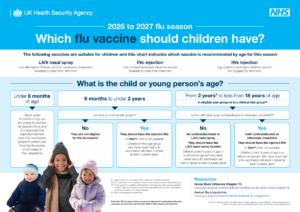
Screenshot 2026 08 04 140348

6 months to 17 years old - Seqirus Cell-based Trivalent Influenza Vaccine – injected flu vaccine

Cell-based Trivalent Influenza Vaccine (Surface Antigen, Inactivated) Seqirus.

It is an inactivated, cell-based flu vaccine given by intramuscular injection. It is egg-free and cannot cause flu.

Some children may be unable or unwilling to tolerate the nasal spray.

If the nasal vaccine cannot be tolerated, please tell the healthcare professional. They can assess your child and, where appropriate, offer an alternative injected flu vaccine.

An injected vaccine may also be used when the nasal vaccine is not medically suitable.

How is the injected vaccine given?

The vaccine is given as an injection into a muscle, usually in the upper arm.

For younger children, it may be given in the thigh.

The healthcare professional will advise you about the vaccine and whether your child needs one or two doses.

Adults aged 18 to 64 years - Seqirus Cell-based Trivalent Influenza Vaccine

You are being offered the Seqirus Cell-based Trivalent Influenza Vaccine, an inactivated flu vaccine given by injection.

This vaccine:

  • Helps protect against the flu strains expected to circulate this season.
  • Is produced using cell culture technology and is egg-free.
  • Does not contain live virus and cannot cause flu.

How is the vaccine given?

The vaccine is given as a single 0.5 mL injection, usually into the upper arm.

The flu vaccine can be given at the same time as other vaccines, including COVID-19 vaccines, using different injection sites where appropriate.

What side effects might occur?

Most side effects are mild and settle within a few days.

Common side effects include:

  • Pain, redness, swelling or bruising at the injection site
  • Headache
  • Muscle aches
  • Feeling tired
  • Mild fever
  • Feeling generally unwell

These reactions are a normal sign that your immune system is responding to the vaccine.

What can I do after vaccination?

After vaccination you can usually continue your normal activities.

If you feel unwell:

  • Rest if needed.
  • Drink plenty of fluids.
  • Keep your arm moving gently if it is sore.
  • If necessary, take paracetamol according to the instructions on the packet, provided you normally can take it safely.

Can the vaccine cause flu?

No.

This is an inactivated vaccine, which means it cannot cause influenza. You may still catch other viruses that cause coughs and colds, and no vaccine provides 100% protection.

Before vaccination

Please tell the healthcare professional if you:

  • Have had a severe allergic reaction to a previous flu vaccine or any of its ingredients.
  • Are currently unwell with a high temperature.
  • Have a bleeding disorder or bruise easily.
  • Have a weakened immune system or are receiving treatment that affects immunity.
  • Have fainted with previous injections.
  • Are pregnant, planning a pregnancy or breastfeeding.
  • Have recently received another vaccine.

Inactivated flu vaccines can be given during pregnancy and while breastfeeding.

When should I seek medical advice?

Contact your GP, pharmacist, NHS 111 or another healthcare professional if:

  • Your symptoms are severe or worsening.
  • Side effects do not improve after a few days.
  • You have concerns about your reaction to the vaccine.

Serious allergic reactions

Serious allergic reactions are very rare.

Seek urgent medical help if you develop:

  • Difficulty breathing
  • Swelling of the face, lips, mouth or throat
  • Severe dizziness or collapse
  • A widespread rash with breathing or circulation problems

Remember

Flu vaccination helps reduce your risk of becoming seriously unwell and helps protect those around you.

If you have any questions about your flu vaccination, please speak to your GP, practice nurse, pharmacist or another healthcare professional.

65 years and over, or turning 65 by 31 March 2027 - Seqirus Adjuvanted Trivalent Influenza Vaccine

Am I eligible for a flu vaccination?

You are eligible for an NHS flu vaccination if you:

  • Are aged 65 years or over, or
  • Will turn 65 years old by 31 March 2027.

The adult flu vaccination programme for 2026/27 starts from 1 October 2026. Your GP practice or vaccination provider will advise you when your vaccination is available.

Which vaccine will I receive?

You are being offered the Seqirus Adjuvanted Trivalent Influenza Vaccine.

This vaccine:

  • Is given as an injection into the upper arm.
  • Is an inactivated flu vaccine and cannot give you flu.
  • Contains an adjuvant, which helps strengthen the body’s immune response to vaccination.
  • Protects against three strains of influenza virus recommended for the 2026/27 flu season.

How is the vaccine given?

The vaccine is given as a single 0.5 mL injection into a muscle, usually in the upper arm.

You only need one dose for the current flu season.

What side effects might I have?

Most side effects are mild or moderate and usually settle within a few days.

Very common side effects include:

  • Pain or tenderness where the injection was given
  • Feeling tired
  • Headache
  • Muscle aches
  • Joint pain

Other possible side effects include:

  • Redness, swelling, bruising or hardening around the injection site
  • Fever
  • Shivering
  • Feeling generally unwell
  • Nausea or diarrhoea
  • Reduced appetite

Most reactions go away within around 3 days.

What can I do after vaccination?

You can normally continue with your usual activities.

If you feel tired or unwell:

  • Get plenty of rest.
  • Drink plenty of fluids.
  • Move your arm gently if it is sore.
  • If appropriate for you, you can take paracetamol according to the instructions on the packet.

Can the vaccine give me flu?

No.

The Seqirus vaccine is an inactivated vaccine, so it cannot cause influenza.

You can still catch other respiratory viruses after vaccination, such as viruses that cause colds.

It also takes some time for your immune system to develop protection following vaccination.

Before vaccination

Please tell the healthcare professional before you are vaccinated if you:

  • Have ever had a severe allergic reaction to a flu vaccine or any of its ingredients.
  • Are currently unwell or have a high temperature.
  • Have a bleeding or clotting disorder.
  • Take medicines that affect blood clotting, such as anticoagulants.
  • Have previously fainted after an injection.
  • Have had a serious reaction following a previous vaccination.
  • Have recently received another vaccine.

The healthcare professional will check that vaccination is appropriate for you.

When should I seek medical advice?

Contact your GP, NHS 111 or another healthcare professional if:

  • You feel very unwell.
  • Your symptoms are severe or getting worse.
  • You are concerned about a reaction following vaccination.

Serious allergic reaction

Serious allergic reactions are very rare.

Seek emergency medical help if you develop:

  • Difficulty breathing
  • Swelling of the face, lips, mouth or throat
  • Severe dizziness or collapse
  • A widespread rash associated with breathing or circulation problems

Remember

The flu vaccine provides the best protection against seasonal flu.

Having your flu vaccination every year is important because the viruses that cause flu change and the vaccine is updated for each flu season.

If you have any questions about your vaccination, please speak to your GP, practice nurse, pharmacist or other healthcare professional.

Seqirus Adjuvanted Trivalent Influenza Vaccine – one injection for the 2026/27 flu season.

COVID-19 vaccinations

Our autumn COVID-19 vaccination programme will begin from 1 October 2026.

The autumn COVID-19 programme is targeted at people at increased risk of serious illness from COVID-19. The eligible groups are:

  • Adults aged 75 years and over.
  • Residents in care homes for older adults.
  • People aged 6 months and over who are immunosuppressed, as defined in the COVID-19 chapter of the Green Book.
COVID 19: The Green Book Chapter
COVID-19 Vaccination – Spikevax®

Why am I being offered a COVID-19 vaccine?

The COVID-19 vaccine helps protect you against serious illness caused by COVID-19.

Your protection can reduce over time, which is why some people are offered a seasonal COVID-19 vaccination.

Your GP practice or vaccination service will advise you if you are eligible.

At Budbrooke in 2026 Autumn covid campaign we are currently only offering Spikevax vaccination (Moderna)

What is Spikevax?

Spikevax® is a COVID-19 vaccine made by Moderna.

It is an mRNA vaccine that helps your immune system recognise and respond to the virus that causes COVID-19.

Spikevax does not contain live coronavirus and cannot give you COVID-19.

The vaccine has been assessed for safety, quality and effectiveness before being authorised for use.

How is Spikevax given?

Spikevax is given as an injection into a muscle, usually in the upper arm.

Your healthcare professional will advise you about the dose you need based on your age and individual circumstances.

What should I expect after vaccination?

Most side effects are mild or moderate and usually improve within a few days.

Common side effects include:

  • Pain, tenderness, redness or swelling where the injection was given
  • Feeling tired
  • Headache
  • Muscle aches
  • Joint pain
  • Chills or shivering
  • Fever
  • Feeling generally unwell

Some people may also experience:

  • Swollen glands
  • Nausea or vomiting
  • Diarrhoea

What can I do if I feel unwell?

If you feel tired or unwell after your vaccination:

  • Rest if you need to.
  • Drink plenty of fluids.
  • Move your arm gently if it is sore.
  • You can take paracetamol according to the instructions on the packet, if you are normally able to take it.

Most side effects settle within a few days.

Can Spikevax give me COVID-19?

No.

Spikevax does not contain live coronavirus and cannot cause a COVID-19 infection.

You can still catch COVID-19 after vaccination, but vaccination helps reduce the risk of serious illness.

Can I have my flu vaccine at the same time?

Yes. If you are eligible for both vaccinations, Spikevax can be given at the same appointment as the flu vaccine.

Your healthcare professional will advise you about your vaccinations.

Before your vaccination

Please tell the healthcare professional before receiving Spikevax if you:

  • Have previously had a severe, life-threatening allergic reaction after a COVID-19 vaccine or any of its ingredients.
  • Have a severely weakened immune system.
  • Have previously experienced myocarditis or pericarditis.
  • Have fainted following an injection or vaccination.
  • Are currently unwell or have a high temperature.
  • Have recently received another vaccination.
  • Are pregnant or breastfeeding.

If you have had an allergic reaction to a previous vaccine or medicine, tell the healthcare professional before vaccination.

If you currently have COVID-19 or are unwell

If you have COVID-19, a high temperature or feel very unwell, you should wait until you are feeling better before having your vaccination.

If you have recently recovered from COVID-19, you do not normally need to wait before having your vaccination.

Rare side effects

Serious allergic reactions are very rare.

Very rare cases of myocarditis (inflammation of the heart muscle) and pericarditis (inflammation around the heart) have been reported following COVID-19 vaccination.

Seek urgent medical attention if, following vaccination, you develop:

  • Chest pain
  • Shortness of breath
  • A fast, fluttering or pounding heartbeat (palpitations)

These symptoms should be assessed urgently.

When should I seek help?

Contact NHS 111 if:

  • Your symptoms are getting worse.
  • Your side effects are not improving.
  • You are worried about your symptoms following vaccination.

Call 999 or attend A&E immediately if you develop severe difficulty breathing, severe chest pain, or symptoms of a serious allergic reaction.

After your vaccination

You can normally continue your usual activities after vaccination.

If you feel tired or unwell, rest and drink plenty of fluids until you feel better.

Remember

COVID-19 vaccination helps protect against serious illness from COVID-19.

Spikevax cannot give you COVID-19.

If you have any questions about your vaccination, please speak to your GP practice, practice nurse, pharmacist or vaccination healthcare professional.

Further information

You can read the official Spikevax Patient Information Leaflet:

Spikevax Patient Information Leaflet – Medicines.org.uk

Important Information

After Care

Looking after yourself

  • Rest if you feel tired or unwell.
  • Drink plenty of fluids.
  • Move your arm gently to prevent stiffness.
  • A cool, damp cloth can help with soreness or swelling.
  • If needed, you can take paracetamol according to the packet instructions, provided you normally can take it safely. You don’t need to take it routinely before vaccination.

Side Effects

Common after-effects

  • Sore, red or swollen arm
  • Tiredness
  • Headache
  • Muscle or joint aches
  • Mild fever, chills or feeling generally unwell
  • Occasionally swollen glands

These usually improve within 1–3 days.

When to seek medical help

Contact NHS 111 or seek medical advice if symptoms are severe, worsening, or haven’t started improving after a few days.

Call 999 urgently if you develop symptoms of a serious allergic reaction, such as difficulty breathing, swelling of the face/throat, or collapse. Serious reactions are very rare.

Reporting Side Effects Following Vaccination

Reporting Side Effects Following Vaccination

Information for patients and GP practice staff

What side effects can occur after vaccination?

Vaccines can cause side effects. Most are mild and short-lived.

Common reactions following flu or COVID-19 vaccination may include:

  • Pain, redness or swelling at the injection site
  • Headache
  • Tiredness
  • Muscle or joint aches
  • Chills
  • Mild fever
  • Feeling generally unwell

For nasal flu vaccination, a runny or blocked nose and headache can occur.

Patients should be advised about the expected side effects of the specific vaccine they receive and when they should seek medical advice.

When should patients seek medical advice?

Patients should contact the GP practice, NHS 111 or another appropriate healthcare professional if:

  • Symptoms are severe or persistent.
  • Symptoms are getting worse rather than improving.
  • They are concerned about a reaction following vaccination.
  • They develop symptoms that are not listed as expected side effects.

Emergency: Call 999 if the patient develops symptoms of a severe allergic reaction, such as difficulty breathing, swelling of the face or throat, collapse or severe dizziness.

Patients with concerning symptoms should receive appropriate clinical assessment. Do not delay urgent treatment while completing a Yellow Card report.


Yellow Card reporting

The Yellow Card Scheme is operated by the Medicines and Healthcare products Regulatory Agency (MHRA). It monitors suspected side effects and other safety concerns associated with medicines and vaccines in the UK.

What should be reported?

Healthcare professionals should consider reporting suspected adverse reactions to vaccines, particularly:

  • Serious or medically significant reactions
  • Unexpected or unusual reactions
  • Reactions in children
  • Reactions in people aged over 65
  • Suspected reactions to vaccines
  • Reactions to medicines or vaccines subject to additional monitoring
  • Suspected reactions where the healthcare professional is unsure whether the vaccine caused the event

For established medicines and vaccines, the MHRA specifically asks healthcare professionals to report all serious suspected adverse drug reactions, even when the reaction is already recognised.

You do not need to prove that the vaccine caused the reaction

A Yellow Card should be considered when there is a suspicion that a medicine or vaccine may have caused an adverse reaction.

You do not need to establish causality before submitting a report.

The MHRA assesses Yellow Card reports alongside other safety information. A report does not mean that the vaccine definitely caused the event.


How to submit a Yellow Card

Healthcare professionals can report a suspected adverse reaction using:

  • The Yellow Card website
  • The Yellow Card app
  • Some GP clinical systems, including EMIS, SystmOne and Vision, where the reporting functionality is available.

Information to include

Provide as much relevant information as possible, including:

  • Patient details sufficient for identification of the report
  • Age and sex
  • Vaccine name and manufacturer
  • Vaccine batch number, where available
  • Date and time of vaccination
  • Dose/number of doses, where relevant
  • Date and time the reaction started
  • Description of the reaction and symptoms
  • Outcome of the reaction
  • Relevant medical history
  • Other medicines being taken
  • Other vaccines or treatments received
  • Any investigations or treatment given
  • Whether the reaction is ongoing or has resolved

The MHRA particularly recommends providing information about medical history, concomitant medicines, timing of treatment and onset, and whether a reaction continued or started after treatment stopped.

If a patient reports a side effect to the practice

  1. Assess the patient’s symptoms and clinical condition.
  2. Provide appropriate advice or treatment.
  3. Establish which vaccine was given, including the brand and batch number where available.
  4. Record the reaction and relevant clinical information in the patient’s medical record.
  5. Consider whether a Yellow Card report is appropriate.
  6. Submit the Yellow Card report where indicated.
  7. Advise the patient that they can also report the suspected reaction themselves.
  8. Document any relevant follow-up or safety-netting advice.

Can patients report directly?

Yes. Patients, parents and carers can submit Yellow Card reports themselves. They can use the Yellow Card website or app. Patients without online access can report by telephone on 0800 731 6789, Monday to Friday, 9am–5pm.

Important

A Yellow Card report is not a substitute for clinical assessment or treatment.

If a patient is seriously unwell, treat the clinical emergency first and complete any required reporting afterwards.

The purpose of Yellow Card reporting is to help the MHRA identify potential safety concerns, monitor vaccine safety and protect patients.

Yellow Card reporting

Yellow Card website:
Report a suspected side effect to the MHRA

Yellow Card telephone service for patients without online access:
0800 731 6789
Monday–Friday, 9am–5pm.