Virtual Waiting Room
Welcome to our Virtual Waiting Room
Your health matters. Stay informed, stay healthy and discover the support available to you.
Just like our waiting room at the surgery, this is a place where you can find helpful information about your health and wellbeing.
We have created this online space to bring together a collection of health information posters, NHS campaigns, useful advice and details of services available to support you and your family.
Whether you want to find out more about looking after your mental health, keeping active, accessing NHS services, screening programmes or preventing illness, we hope you will find something useful.
We are also taking steps to be more environmentally friendly. By making information available digitally, we hope to reduce the amount of paper we use for printed posters and leaflets in the surgery. This is a small but positive step towards reducing waste while making useful health information available to you whenever you need it.
We hope you enjoy exploring our Virtual Waiting Room and find it a helpful resource.
Explore our patient information
Important NHS Guidance & Patient Rights
At Budbrooke Medical Centre, we want all our patients to feel safe, respected, listened to and involved in decisions about their healthcare.
The NHS has introduced a number of important initiatives to improve patient safety, dignity, communication and the quality of care.
This page explains some of these initiatives, what they mean for you and your family, and how you can speak up if you have concerns.
1. Chaperones – Your rights and your child’s safety
We are committed to protecting the privacy, dignity and safety of all our patients during examinations and procedures.
A chaperone is an appropriately trained member of staff who is present during an examination to support the patient, provide reassurance and act as an impartial observer.
Chaperones for adults
You will be offered a chaperone before an intimate examination, such as an examination of the breasts, genital area or rectum.
- You can request a chaperone at any time.
- You can accept or decline the offer.
- You can ask whether a male or female chaperone is available.
- You may also have a family member or friend present for additional support.
- A family member or friend does not automatically replace a formal chaperone.
- If you request a chaperone and one is unavailable, we will discuss alternative arrangements with you.
Chaperones for babies, children and young people under 18
Following updated NHS England guidance published in December 2025, a formal, appropriately trained chaperone should be present during intimate examinations of children and young people under the age of 18.
This includes babies and infants.
For example, if a baby or child needs an intimate examination involving their genital area, a formal chaperone should be present.
For parents and carers:
- A formal chaperone should be arranged for intimate examinations of children and young people under 18.
- A parent, guardian or trusted adult may also be present to provide comfort and reassurance.
- A parent or carer does not replace the formal chaperone.
- The clinician will explain why the examination is needed and what it involves.
- Appropriate consent will be obtained from the parent or guardian where required, and the child’s understanding and wishes will be considered according to their age and capacity.
What if a chaperone is not available?
If a formal chaperone is requested but unavailable, the examination will normally be rearranged within a reasonable timeframe, taking account of the urgency of the patient’s medical needs.
If delaying the examination could put the patient’s health at risk, the clinician will discuss the situation and appropriate action with the patient or parent/guardian.
Why are chaperones important?
Chaperones help to:
- Protect patients’ privacy, dignity and safety.
- Provide reassurance during sensitive examinations.
- Support children, babies and vulnerable patients.
- Help ensure examinations are carried out appropriately.
If you would like to discuss chaperone arrangements before an appointment, please contact our reception team.
Your dignity, safety and comfort are important to us.
2. Jess’s Rule – Three strikes and we rethink
Jess’s Rule is a patient safety initiative introduced across general practice in England in memory of Jessica Brady, who sadly died from cancer at the age of 27.
It encourages GP teams to take a fresh look at a patient’s symptoms if they have attended three times with the same or worsening symptoms, particularly where there is no clear diagnosis or the symptoms are not improving.
The principle is:
Reflect – Review – Rethink
- Reflect: Listen carefully to the patient’s concerns and consider what has changed.
- Review: Look again at the symptoms, medical history and any possible warning signs.
- Rethink: Consider further investigations, a colleague’s opinion or referral to a specialist where appropriate.
What does this mean for you?
If you have attended the practice several times about the same problem and your symptoms are continuing, worsening or remain unexplained, please tell us.
You should feel able to say:
- My symptoms are not getting better.
- I am worried something has been missed.
- This is not normal for me.
- I would like my symptoms and previous consultations to be reviewed.
Jess’s Rule supports clinicians to reconsider a diagnosis when concerns persist. It does not mean every patient automatically needs tests or a hospital referral after three appointments.
Please do not wait for a third appointment if your symptoms are getting worse or you are worried. Contact us sooner.
3. The Oliver McGowan Mandatory Training on Learning Disability and Autism
The Oliver McGowan Mandatory Training was introduced to improve how health and social care staff understand and support people with a learning disability and autistic people.
It is named after Oliver McGowan, whose death highlighted the importance of healthcare staff having the right knowledge and skills to provide safe and appropriate care.
Health and social care providers registered with the Care Quality Commission (CQC) have a statutory responsibility to ensure their staff receive learning disability and autism training appropriate to their role.
What does this mean for patients?
Healthcare staff should:
- Communicate clearly and respectfully.
- Take time to understand individual needs.
- Listen to patients, families and carers.
- Make reasonable adjustments to help patients access care.
- Recognise that people may communicate pain, distress or illness differently.
- Involve patients in decisions about their care and support their individual needs.
You can help us support you
Please tell the practice if you have a learning disability, are autistic or need additional support when attending appointments.
You can ask us about reasonable adjustments, such as:
- Longer appointments.
- Easy Read or accessible information.
- A quieter waiting area.
- Support with communication.
- Help from a carer or advocate where appropriate.
We want everyone to feel comfortable and supported when accessing our services.
4. Martha’s Rule – When you are worried about someone in hospital
Martha’s Rule is an NHS patient safety initiative introduced following the death of Martha Mills, whose family raised concerns about her deteriorating condition while she was in hospital.
It aims to make sure patients, families and carers are listened to when they are worried that someone’s condition is getting worse.
What does Martha’s Rule mean?
If you or someone you care for is in hospital and you are concerned that their condition is deteriorating:
- Tell the nurse or doctor looking after the patient.
- Explain clearly what has changed and why you are worried.
- If you feel your concerns are not being addressed, ask about Martha’s Rule and the hospital’s rapid review process.
- You may be able to request an urgent review by a different clinical team.
Martha’s Rule is being implemented across NHS hospital inpatient services in England. The arrangements and contact numbers vary between hospitals, so ask the ward team or check the hospital website.
Important: Martha’s Rule relates primarily to hospital inpatient care. It is not a separate rapid-review service provided by GP practices.
5. Reasonable Adjustments – Making healthcare accessible to everyone
Everyone should be able to access healthcare in a way that meets their needs.
If you have a disability, learning disability, autism, communication difficulty or another condition that affects how you access healthcare, you may be entitled to reasonable adjustments.
Examples include:
- Longer appointments.
- Easy Read or large-print information.
- Help with communication.
- A quieter waiting area.
- Support from a carer or advocate.
- Assistance with accessing online or telephone services.
Please let us know what would help you. We can discuss your needs and consider how best to support you.
6. Accessible Information Standard
The NHS Accessible Information Standard is designed to make sure that people with a disability, impairment or sensory loss receive information in a format they can understand and can communicate effectively with healthcare services.
This may include:
- Large-print letters.
- Easy Read information.
- British Sign Language (BSL) interpretation.
- Communication support.
- Information in alternative formats.
If you need information in a different format or require communication support, please let us know when contacting the practice.
7. Speaking Up – Your concerns matter
We want patients to feel confident raising concerns about their health or the care they receive.
If you feel you have not been listened to, your symptoms are worsening or you are unhappy with the care provided, please speak to a member of the practice team.
You can ask for your concerns to be reviewed or explained further.
If you wish to make a formal complaint, please contact the practice and ask for information about our complaints procedure.
You can also find information about NHS complaints and your rights through the NHS website.
8. Getting urgent medical help
If you need urgent medical advice outside normal GP opening hours, contact NHS 111 online or by telephone.
- NHS 111: For urgent medical advice when you are unsure where to go.
- 999: For life-threatening emergencies, such as suspected heart attack, stroke, severe breathing difficulties or serious injury.
- A&E: For serious injuries and emergencies requiring hospital assessment.
If you are worried that your symptoms are getting worse, please seek medical advice rather than waiting for a routine appointment.
Our commitment to you
At Budbrooke Medical Centre, we are committed to treating patients with dignity, respect and compassion.
We want you to feel:
- Listened to and taken seriously.
- Involved in decisions about your care.
- Comfortable asking questions.
- Supported with any additional needs.
- Confident about raising concerns.
Your voice matters. Your safety matters. Please speak to us if you need help or have concerns about your care.

Your Information, Confidentiality & Privacy
How We Use and Protect Your Personal Data
At Budbrooke Medical Centre, we take your privacy and the confidentiality of your personal information very seriously.
When you register with our practice or receive healthcare from us, we collect and hold information about you to help provide safe, effective and appropriate care.
This page explains what information we collect, how we use it, who we may share it with and your rights.
1. What information do we collect?
We may collect and hold information such as:
- Your name, address, date of birth and contact details.
- Your NHS number and GP registration details.
- Details about your health, medical history and current conditions.
- Medication and prescription information.
- Test results, investigations and referrals.
- Information about appointments and consultations.
- Relevant information provided by hospitals, other healthcare professionals or services involved in your care.
- Information about your communication needs or reasonable adjustments.
We only collect information that is relevant and necessary for providing healthcare and managing our services.
2. Why do we use your information?
We use your personal information to:
- Provide medical care and treatment.
- Arrange appointments and manage your healthcare.
- Prescribe medication and manage repeat prescriptions.
- Request and review blood tests, investigations and results.
- Refer you to hospitals, specialists and other healthcare services.
- Communicate with you about your care.
- Maintain accurate medical records.
- Monitor and improve the quality and safety of our services.
- Meet our legal and regulatory responsibilities.
Your information helps healthcare professionals make informed decisions about your treatment and ongoing care.
3. Who might we share your information with?
Your information may be shared securely with other healthcare professionals and organisations involved in your care, where appropriate.
This may include:
- Hospitals and NHS specialist services.
- Community nurses and other healthcare professionals.
- Community pharmacists.
- Out-of-hours GP services.
- NHS 111 and emergency services.
- Other NHS organisations involved in your treatment.
- Social care services, where relevant and lawful.
- Organisations providing approved NHS services on our behalf.
We only share information when there is an appropriate legal basis to do so and when it is necessary and proportionate.
Information may also be shared where we have a legal obligation or where necessary to protect someone from serious harm.
4. Will my information be kept confidential?
Yes. Everyone working at or providing services on behalf of the practice has a duty to maintain patient confidentiality.
Your medical records are stored securely and only accessed by authorised individuals who need the information to carry out their role.
We do not disclose your confidential medical information to family members, friends or other individuals without an appropriate legal basis or your permission, except where an applicable legal or safeguarding reason allows or requires disclosure.
5. Can family members or carers access my information?
Your medical information is confidential.
If you would like a family member, friend or carer to help manage your healthcare, you can ask the practice about arranging appropriate permission or proxy access.
For children and young people, access arrangements depend on the child’s age, understanding, competence and individual circumstances.
We will always consider confidentiality and the patient’s best interests.
6. How is my information used to improve NHS services?
Some patient information may be used to help plan, monitor and improve NHS services, support public health and carry out research.
Where possible, information is anonymised or otherwise protected so that individuals are not directly identified.
There are also national NHS data programmes, including the General Practice Data for Planning and Research (GPDPR) programme. Patients can find out more about how their information may be used and the choices available to them through NHS England.
7. Your NHS Summary Care Record
Your Summary Care Record contains important information from your GP record, such as your current medication, allergies and details of any previous reactions to medicines.
It can help authorised healthcare professionals provide safer care, particularly when you receive treatment away from your usual GP practice.
You can find out more about your Summary Care Record and your choices by contacting the practice or visiting the NHS website.
8. Your rights over your personal information
Under data protection law, you have a number of rights, including:
- The right to be informed about how your information is used.
- The right to request access to your personal information.
- The right to request correction of inaccurate information.
- The right to request restriction of certain processing in particular circumstances.
- The right to object to certain uses of your information.
- The right to raise a concern about how your information is handled.
Some rights are subject to legal exemptions, particularly where information is contained in medical records or is needed to provide healthcare.
You can contact the practice if you would like to access your medical records or ask a question about your personal information.
9. How do I access my medical records?
You can request access to your medical records by contacting the practice.
You may also be able to view parts of your GP health record through the NHS App, depending on the access enabled for your account.
Find out more:
https://www.nhs.uk/nhs-app/
10. Cookies and our website
Our website may use cookies or similar technologies to help it function properly, understand how visitors use it and improve the online experience.
Please refer to our website cookie information for details of the cookies used and how you can manage your preferences.
11. Who can I contact about my information?
If you have questions about how your personal information is used, stored or shared, please contact the practice and ask to speak to the Practice Manager or Data Protection Lead.
You also have the right to raise concerns with the Information Commissioner’s Office (ICO).
ICO website:
https://ico.org.uk/
Telephone: 0303 123 1113
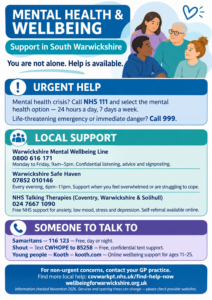
🧠 Mental Health & Wellbeing
Information about anxiety, depression, stress, emotional wellbeing and where to find support.
Useful links:
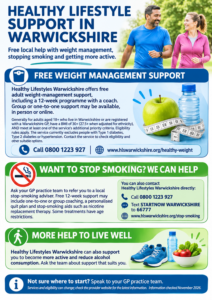
🥗 Healthy Living
Advice on healthy eating, exercise, weight management, stopping smoking and improving your lifestyle.
- Healthy Lifestyles Warwickshire
0800 1223 927
Freephone
Text: STARTNOW WARWICKSHIRE to 66777
Website: Healthy Lifestyles Warwickshire
- Weight management
Free weight management programme
Eligibility criteria apply. The current adult programme has additional priority criteria and excludes people with Type 1 diabetes, Type 2 diabetes or hypertension.
- Stop smoking
Patients can self-refer or ask the GP practice to refer them.
❤️ Screening & Prevention
SCREENING & PREVENTION
Early detection can save lives
Don’t ignore your NHS screening invitations. Take up the opportunity to protect your health.
🎀 Breast screening
-
Offered every 3 years from age 50 up to the 71st birthday.
-
Women aged 71 and over can request screening.
🌸 Cervical screening
-
Offered to women and people with a cervix aged 25–64.
-
Usually every 5 years.
-
Contact your GP practice if you think you are overdue.
💙 Bowel cancer screening
-
Offered every 2 years to people aged 50–74.
-
Complete your home testing kit when it arrives.
-
Age 75 and over? Request a kit by calling 0800 707 6060.
❤️ Abdominal Aortic Aneurysm (AAA)
-
Offered to men during the year they turn 65.
-
Men over 65 can self-refer if they have not been screened.
👁️ Diabetic eye screening
-
Offered to people with diabetes aged 12 and over.
-
Usually every 1–2 years, depending on previous results.
🩺 NHS Health Checks
-
Offered to eligible adults aged 40–74.
-
Usually every 5 years.
-
Helps identify risk factors for heart disease, stroke, kidney disease and diabetes.
💙 Prostate Cancer Awareness & PSA Testing
Know your risk. Know the symptoms. Talk to your GP.
-
PSA stands for Prostate Specific Antigen – a blood test that can help investigate prostate problems, including prostate cancer.
-
Men aged 50 and over can speak to their GP about requesting a PSA test, even if they have no symptoms.
-
Black men and men with a family history of prostate cancer may have a higher risk and should consider discussing this with their GP from age 45.
-
A PSA test has limitations and can produce abnormal results for reasons other than cancer. Discuss the benefits and risks before deciding.
Symptoms to look out for:
-
Difficulty starting to urinate.
-
Weak or interrupted urine flow.
-
Needing to urinate more frequently, particularly at night.
-
Blood in urine or semen.
Speak to your GP if you notice any changes.
Find out more: Prostate Cancer UK
-
Not received an invitation?
Contact your GP practice or the relevant NHS screening service to check your eligibility.
IMPORTANT
Do not wait for a screening invitation if you have symptoms or notice changes to your body. Contact your GP practice promptly.
Find out more: www.nhs.uk/tests-and-treatments/nhs-screening/
Useful links:
💉 Vaccinations & Immunisations
Vaccinations are one of the most effective ways to protect ourselves, our children and those around us from serious infectious diseases.
At our practice, we encourage all eligible patients to keep up to date with their routine vaccinations and immunisations. Vaccines help your immune system recognise and fight infections, reducing the risk of serious illness, complications and hospital admission.
Whether you are expecting a baby, have young children, are a teenager or are an older adult, there may be important vaccinations available to you.
👶 Baby & Childhood Vaccinations
Babies and young children are offered a programme of routine vaccinations to protect them against serious infections during their early years.
These include protection against:
- Diphtheria, tetanus, whooping cough, polio, hepatitis B and Hib.
- Rotavirus.
- Meningitis B.
- Pneumococcal disease.
- Measles, mumps, rubella and chickenpox (MMRV).
Vaccinations are offered at different ages as your child grows. It is important to attend appointments when invited.
🧑🎓 Teenagers & Young People
Vaccinations during the teenage years provide important protection as children grow into adulthood.
These include:
- HPV vaccination: Helps protect against human papillomavirus infections, which can cause several types of cancer.
- MenACWY vaccination: Protects against four types of meningococcal bacteria that can cause meningitis and septicaemia.
- Teenage booster: Provides continued protection against tetanus, diphtheria and polio.
If your child has missed a school vaccination, please contact the relevant school immunisation service to discuss catch-up arrangements.
🤰 Vaccinations During Pregnancy
Vaccinations during pregnancy help protect both mother and baby.
Eligible pregnant women are offered:
- Whooping cough (pertussis): Helps protect newborn babies against whooping cough during their first weeks of life.
- RSV vaccination: Helps protect babies against respiratory syncytial virus, which can cause serious chest infections.
- Flu vaccination: Helps protect pregnant women and their babies against influenza.
Please speak to your midwife or GP practice if you have questions about vaccinations during pregnancy.
💙 Adult Vaccinations
Vaccinations remain important throughout adulthood. Some infections can cause more serious complications as we get older or if we have certain medical conditions.
Depending on your age and eligibility, you may be offered:
Flu vaccination
The seasonal flu vaccine helps protect people at increased risk of complications from influenza. It is offered each year to eligible patients.
COVID-19 vaccination
Seasonal COVID-19 vaccinations are offered to eligible groups to help reduce the risk of serious illness.
Shingles vaccination
The shingles vaccine helps protect against shingles and its complications. It is routinely offered to eligible older adults and some people with weakened immune systems.
Pneumococcal vaccination
Helps protect against pneumococcal infections, which can cause pneumonia, meningitis and blood infections.
RSV vaccination
Helps protect eligible older adults against respiratory syncytial virus, which can cause serious respiratory illness.
❤️ Why Are Vaccinations Important?
Vaccinations:
- Protect against serious infectious diseases.
- Reduce the risk of complications and hospital admissions.
- Help protect babies, older people and vulnerable members of our community.
- Reduce the spread of infections.
- Provide protection throughout different stages of life.
Have You Missed a Vaccination?
If you or your child have missed a routine vaccination, please don’t worry.
Contact our practice and we can check your vaccination record and advise on the next steps. Many missed vaccinations can be caught up.
If you are unsure whether you are up to date, please get in touch.
Where Can I Find More Information?
For reliable information about vaccinations, eligibility and the current NHS immunisation schedule, visit:
- NHS Vaccinations: https://www.nhs.uk/vaccinations/
- NHS Pregnancy and Baby Vaccinations: https://www.nhs.uk/pregnancy/keeping-well/vaccinations/
- UK Health Security Agency (UKHSA): https://www.gov.uk/government/collections/immunisation
Need Help or Have a Question?
If you have any questions about your vaccination status, eligibility or upcoming appointments, please contact our reception team or speak to a member of our clinical team.
A simple vaccination today can help protect your health tomorrow.
Please note: Vaccination eligibility and schedules can change. The information above is general guidance and your individual eligibility will depend on your age, health circumstances and current NHS guidance.
👨👩👧 Family Health
Useful links for patients:
Family health – useful links for patients
1. Older people and elderly care
-
NHS – Social care and support – help at home, care assessments, equipment, care homes and support for families.
-
Age UK – Information and advice – advice on health, money, benefits, housing, loneliness and care options.
-
Independent Age – information and advice for older people, including finances and social care.
-
NHS – Falls prevention – information about falls, reducing risks and getting help.
2. Carers and family members
-
Warwickshire County Council – Support for carers – local support, carer assessments, breaks and advice.
-
Caring Together Warwickshire – support for unpaid carers, including advice and opportunities to meet other carers. Telephone: 0800 197 5544.
-
Carers UK – practical and emotional support, benefits advice and information about carers’ rights.
-
NHS – Carer’s assessments – explains how to request an assessment and what support may be available.
-
Mobilise – online information and peer support for unpaid carers.
3. Dementia and memory support
-
NHS – Dementia: help and support – advice for people living with dementia and their families.
-
Alzheimer’s Society – information, advice and local support. Dementia Support Line: 0333 150 3456.
-
Dementia UK – specialist advice from Admiral Nurses. Helpline: 0800 888 6678.
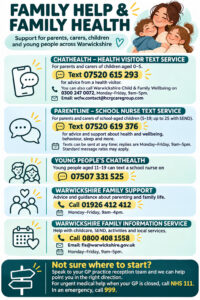
4. Parents, babies and children
-
Warwickshire Family Information Service – local information about parenting, childcare, family support, SEND and financial help. Freephone: 0800 408 1558.
-
Warwickshire Child and Family Wellbeing Service – health visiting and school nursing support, from pregnancy through to age 19 (or 25 for young people with SEND). Telephone: 0300 247 0072.
-
NHS – Services and support for parents – health visitors, child health clinics and support for new parents.
-
Contact – support for families with disabled children.
-
Family Lives – parenting advice and family relationship support.
5. Support with care, disability and daily living
-
GOV.UK – Find your local council – access local adult social care and support services.
-
NHS – Care and support at home – information about home care, equipment and adaptations.
-
NHS – Help with health costs – information about help with prescriptions, dental treatment and other NHS costs.
-
GOV.UK – Benefits calculators – check which benefits someone may be entitled to.
🏥 Accessing NHS Services
Useful NHS links for patients
These are good links to include beneath the article or as separate buttons on your Virtual Waiting Room page:
-
NHS – You and your general practice – what patients can expect from their GP practice and how to access care.
-
NHS App – appointments, prescriptions and health information.
-
NHS 111 – urgent medical advice.
-
NHS – Find a pharmacy – locate a local pharmacy.
-
NHS – Pharmacy First – conditions pharmacists may be able to assess and treat.
-
NHS – Find an urgent treatment centre – find urgent care services.
-
NHS – Find a GP – find or register with a GP practice.
-
NHS – Help with the NHS App – support with using the app.
-
NHS – Family and carer access – information about managing services for someone else.
🌸 Women's & Men's Health
Women’s & Men’s Health
Your health matters at every stage of life. Our GP practice is here to support you with a wide range of women’s and men’s health concerns.
Some health issues can feel embarrassing or difficult to talk about, but please remember that our healthcare team is here to listen and help. You do not need to feel uncomfortable about asking for advice.
You can contact the practice to discuss symptoms, arrange an appointment or find out which service is most appropriate for your needs.
Women’s Health
We can offer advice, assessment and support for a range of women’s health concerns, including:
Periods and menstrual health
- Painful, heavy, irregular or missed periods.
- Premenstrual syndrome (PMS).
- Endometriosis and polycystic ovary syndrome (PCOS).
- Bleeding between periods or after sex.
Menopause and perimenopause
- Hot flushes and night sweats.
- Changes in mood, sleep and concentration.
- Vaginal and urinary symptoms.
- Advice about hormone replacement therapy (HRT) and other treatment options.
Contraception and reproductive health
- Discussing suitable contraception options.
- Contraceptive pill reviews and advice.
- Family planning and pregnancy planning.
- Fertility concerns and trying to conceive.
Breast health
- Breast pain, lumps or changes in breast appearance.
- Advice about breast awareness and screening.
- Support with concerns about breast health.
Cervical screening
- Cervical screening (smear tests) is offered to eligible patients.
- Please contact the practice if you have received an invitation or believe you are due.
- Screening is important even if you feel well.
Pregnancy and postnatal health
- Advice when planning a pregnancy.
- Booking and antenatal care information.
- Postnatal physical and emotional wellbeing.
Men’s Health
We encourage men to look after their health and seek advice if something does not feel right.
Our team can help with concerns including:
Prostate and urinary health
- Difficulty passing urine or a weak urine flow.
- Needing to pass urine frequently, particularly at night.
- Blood in the urine.
- Prostate health concerns and discussions about PSA blood testing.
Testicular health
- Lumps, swelling or changes in the testicles.
- Pain or discomfort.
- Advice on recognising changes and knowing what is normal for you.
Sexual health
- Erectile dysfunction.
- Changes in sexual function or libido.
- Sexual health concerns and advice about appropriate services.
Fertility and reproductive health
- Fertility concerns.
- Advice when planning a family.
- Hormonal or reproductive health concerns.
General men’s health
- Blood pressure and cardiovascular health.
- Diabetes and cholesterol checks.
- Weight management and healthy lifestyle advice.
- Mental health, stress, anxiety and low mood.
Screening and prevention
Screening can help identify certain health conditions at an early stage, sometimes before symptoms develop.
Depending on your age and circumstances, you may be invited for:
- Cervical screening.
- Breast screening.
- Bowel cancer screening.
- Abdominal aortic aneurysm (AAA) screening for eligible men.
- NHS Health Checks, if eligible.
Please attend screening appointments when invited. If you have symptoms or concerns, do not wait for a screening invitation – contact your GP practice.
When should I contact the practice?
Please contact us if you notice a new, persistent or worrying symptom, or if you would like advice about your health.
Examples include:
- Unusual bleeding, including bleeding after the menopause.
- A new breast lump or change in your breast.
- A lump or swelling in a testicle.
- Changes in your usual urinary habits.
- Persistent pelvic, abdominal or testicular pain.
- Unexplained weight loss.
These symptoms do not necessarily mean something serious is wrong, but it is important to have them assessed.
Seek urgent medical help if you have sudden, severe testicular pain, severe abdominal pain, heavy bleeding with dizziness or collapse, or another serious or rapidly worsening symptom. Call 999 for a life-threatening emergency.
Your privacy and confidentiality
We understand that some health concerns are personal. Our staff are experienced in discussing sensitive issues and will treat your information with respect and confidentiality.
You can request a male or female clinician where available. You can also ask for a chaperone during an examination.
Please don’t put off seeking help. We are here to support you.
Useful links for patients
These are reliable NHS and specialist resources
Information about periods, menopause, contraception, pregnancy, breast health and more.
Cervical Screening – NHS
Who is eligible, what happens during screening and how to arrange an appointment.
Prostate Cancer UK
Information about prostate health, symptoms, risk and PSA testing.
Testicular Health – NHS
How to check your testicles and recognise changes that need medical attention.
Sexual Health – NHS
Contraception, sexually transmitted infections and local sexual health services.
🤝 Community Support & Local Services
Community Support & Local Services
Local help, advice and support for you and your family
Community organisations can provide practical help, social activities, emotional support and advice with everyday challenges. You do not need to manage everything alone. There are local services that may be able to help you or someone you care for.
Local services and organisations
1. Finding local community groups and activities
SearchOut Warwickshire
A really useful starting point for finding local clubs, support groups, community activities, events and organisations. You can search by location or type of support.
2. Older people and living independently
Age UK Coventry & Warwickshire
Information and support for older people, including staying independent, social activities, advice and help for people experiencing loneliness.
Dementia support
Find information about dementia, support for families and carers, and local day opportunities.
3. Support for unpaid carers
Caring Together Warwickshire
Support for people looking after a relative, friend or neighbour. Help includes advice, emotional support, carer assessments, groups and information about breaks from caring.
Freephone: 0800 197 5544
4. Mental health and emotional wellbeing
Wellbeing for Warwickshire
Free support for adults, including a helpline, wellbeing practitioners, community links and welcoming drop-in hubs. No referral or appointment is needed to attend a hub.
Freephone: 0800 616171
Springfield Mind
Mental health information, support and wellbeing services across the local area.
5. Family, children and young people
Warwickshire Family Information Service
Information about childcare, family support, children’s activities and services for children and young people.
Warwickshire Parent Carer Voice
Support and information for parents and carers of children and young people with special educational needs and disabilities (SEND).
6. Money, debt, housing and benefits advice
Citizens Advice South Warwickshire
Free, confidential advice about benefits, debt, money worries, housing, employment and other everyday problems.
Telephone: 0808 250 5715
Food banks and emergency food support
If you are struggling to afford food, Warwickshire County Council provides information about local food banks and how to access help.
Act on Energy
Free advice for Warwickshire residents worried about energy bills, heating costs or keeping their home warm.
Telephone: 0800 988 2881
7. Transport and getting to appointments
VASA Community Transport
Community transport and activities, including support for older and vulnerable people who may struggle to access local services.
Your health. Your information. Your wellbeing.
Please remember that the information provided is for general guidance and does not replace individual medical advice. If you are concerned about your health, please contact the practice or use the appropriate NHS service.
Thank you for visiting our Virtual Waiting Room.
Helpful Pages on Budbrooke's Website
Access to your Medical Records
Blood Tests for Housebound Patients